
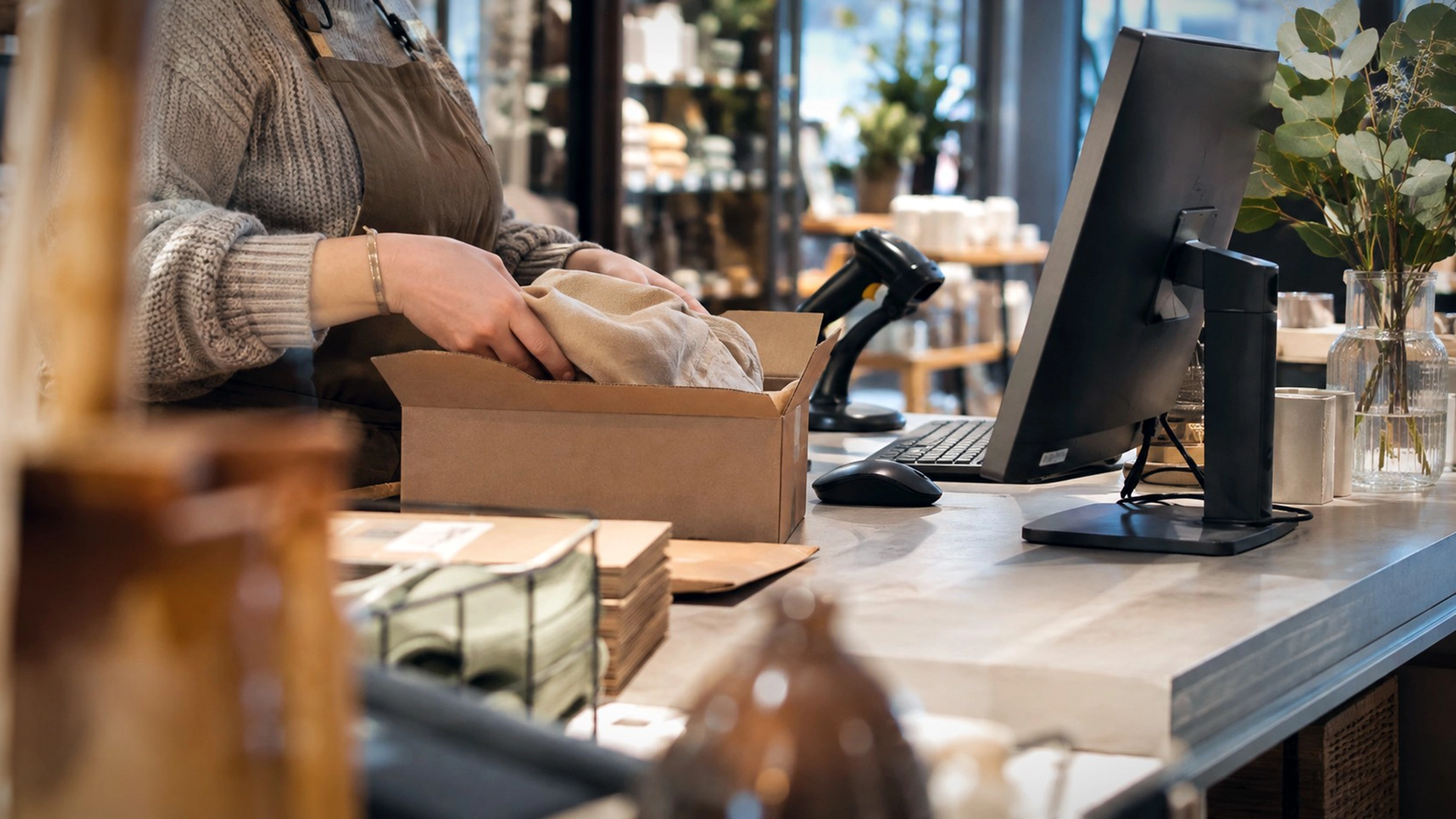
Do you sell both in-store and online? Having two sales channels doesn’t have to mean double the work. When your ERP system and online store work together, order processing becomes easier, inventory levels stay more up to date, and your store’s day-to-day operations run more smoothly.
For your customers, a brick-and-mortar store and a webshop are simply two ways to shop at the same store. Behind the scenes, however, managing these two sales channels can be significantly more complex. Inventory levels must be updated, online orders processed, and returns handled - all while ensuring that purchasing and other daily operations run smoothly. In practice, the seamless integration of the store and online store comes down to three key areas: inventory data, order and return processing, and purchasing.
Keep your inventory information up to date
Purchases, returns, and other changes should be updated seamlessly from one sales channel to another. Incorrect inventory data can lead to overselling, disappointed customers, and extra work for staff. Updating product information and prices separately in different systems also takes time and increases the risk of errors.
When the point-of-sale system and the webshop use the same up-to-date product information, prices, and inventory levels, there is no need to update them separately in both systems. In-store sales and inventory management are handled in the store system, and the online store integrated with it uses the same data for online sales.
Instead of maintaining separate product registries and manually updating inventory levels, your staff can leverage consistent data across both sales channels. This reduces administrative work and helps ensure that customers can trust the availability information displayed in the online store.
Streamline the processing of orders and returns
Online orders and returns run most smoothly when the store system and the webshop share the same customer and order data. Online orders must be processed, products must be prepared for shipment, and sometimes customers want to exchange or return the products they’ve purchased. When the brick-and-mortar store and the online store operate on separate systems, day-to-day tasks can involve unnecessary steps, such as:
- Manually transferring online orders to another system for processing.
- Searching for purchase information when a customer returns a product purchased from the webshop to a physical store.
- Updating inventory data separately after returns or exchanges.
Compatible systems help reduce this duplication of effort.
When the point-of-sale system and the webshop share customer and order data, store employees can view the necessary purchase information when processing online returns. Inventory levels can also be updated as part of the process of handling returned products.
A webshop integrated with a point-of-sale or enterprise resource planning system allows orders to be processed as part of the existing order process without the need for separate manual data entry. This means less time is spent transferring data and more time is spent serving customers and processing orders.
What would a smoother day-to-day routine look like at your company?
Online orders, in-store returns, inventory levels, and restocking orders - when the systems work together, every step is based on the same data. Book a demo, and we’ll show you how this works in practice.
Integrate Sales, Purchasing, and Customer Service
Keeping inventory data up to date is one thing. Another is ensuring that the right products are available when your customers want to buy them.
When sales come from both brick-and-mortar stores and a webshop, retailers must stay up to date on which products are selling, what needs to be restocked, and when it’s time to place new orders. For businesses with a wide product range or more complex purchasing processes, this can require a significant amount of coordination. This is where an enterprise resource planning (ERP) system can be a great help.
An enterprise resource planning (ERP) system integrates sales, purchasing, inventory management, and invoicing into a single solution. When it also includes point-of-sale functionality, retail sales can be managed as part of the same integrated system. Purchase recommendations can simplify inventory replenishment planning, and standardized processes reduce the need for repetitive data entry between sales orders, purchases, and invoicing.
When an ERP system is integrated with an online store, product, order, and inventory data flows between the system and the webshop. This makes it easier to coordinate purchasing and inventory management according to the needs of both sales channels.
Brick-and-mortar store and webshop as part of the same business
Running a brick-and-mortar store and an webshop shouldn’t mean that you have to manage different aspects of the business separately. From product information and customer orders to inventory management and purchasing, integrated systems can reduce manual work and streamline day-to-day operations.
At Confirma, we help retail companies find the right combination of point-of-sale, e-commerce, and enterprise resource planning solutions to meet their needs.
- Confirma Flowvy is an e-commerce platform for consumer and business sales. It includes pre-built integrations with both Confirma’s own and third-party ERP systems, enabling product, order, and inventory data to flow between the online store and the physical store.
- Confirma Jeemly is an enterprise resource planning (ERP) system for the retail industry that integrates point-of-sale, inventory management, purchasing, and other systems. It is particularly well-suited for store-based retail, such as specialty stores, grocery stores, and flea markets.
- Confirma Quick3 is a browser-based enterprise resource planning (ERP) system that integrates sales, purchasing, inventory, and maintenance. It is particularly well-suited for technical retailers, spare parts stores, and maintenance companies.
Do you already sell both in-store and online? Let’s have a look at your current setup together and figure out how we can make your day-to-day operations easier.
